

Story Highlights
- Indie developers are turning their game characters into physical collectibles, giving fans something memorable beyond the screen.
- Smart artwork, card layouts, and finishes like foil or holographic effects can make characters feel more special and desirable.
- Collectible cards create new ways for fans to trade, share, and engage with the game community.
Indie developers sink months, sometimes years, into the characters they create. Unluckily, however, a screenshot of that character could get scrolled past in two seconds. A printed card of the same character, on the other hand, sitting on a desk or tucked into a backer reward box, doesn’t get scrolled past. It just stays there. That’s the idea behind why more small studios are putting their characters on trading cards.
Why Game Merch Matters More Than You Think It Does
Merchandise means something different for a studio without a AAA marketing budget. It’s not extra income so much as proof that a game’s world actually resonates with people. A character sprite is easy to forget. A card sitting in a Kickstarter reward tier, or handed out at a convention table, is something a fan chooses to keep, that’s for sure.
Backers, especially, who get a card set feel like they own a piece of the game’s identity, not just a license key. Cards travel well too. They’re light, cheap to ship internationally, and they don’t eat into a crowdfunding budget the way apparel or plush toys do.
Cards are also a cheap way to find out which characters people actually connect with, before anyone spends money on something like plushies or acrylic stands.
The Design Philosophy Bringing Trading Cards To Life
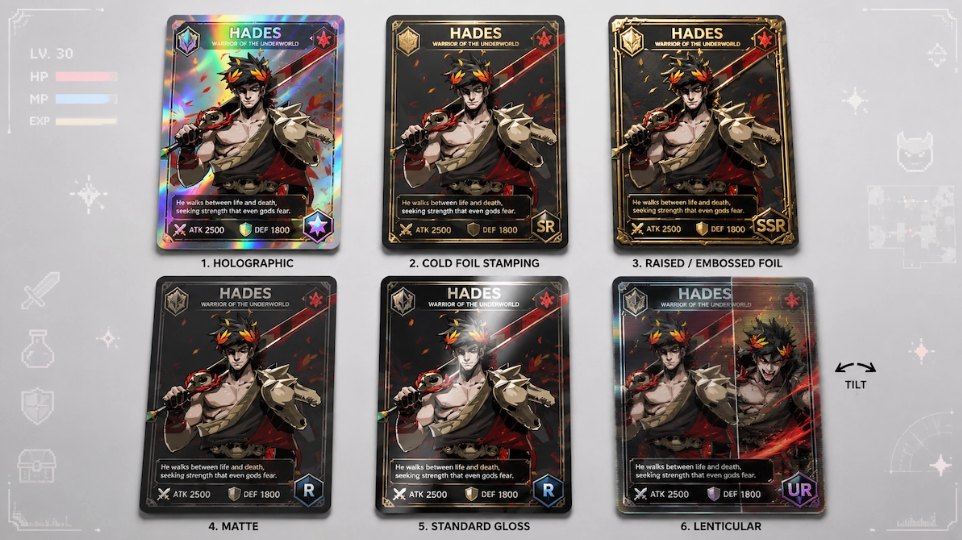
Card design starts where character design already started. This includes silhouette, color, and a pose you can read in half a second. Shrink all that down to card size and most of it survives if it was built right the first time.
What indie teams add on top comes straight from TCG convention, which is usually a name plate, one line of flavor text lifted from the lore, and a stat block if the card’s meant to sit next to the game.
Finish is where the real decision is. Foil on a rare character is doing the same job a loot drop does. You pull it, and for a second it feels earned. Matte on the commons isn’t the cheap option. It’s what makes the foil ones worth pulling in the first place. Put foil on everything and nothing feels rare anymore.
| Finish | Best For | Visual Feel | Design Tip |
|---|---|---|---|
| Holographic | Rare/"legendary" characters, chase cards | Shifts and sparkles under light | Keep the holographic area simple — busy linework tends to get lost in the shimmer |
| Cold foil stamping | Logos, borders, small metallic accents | Sharp, reflective shine on flat surfaces | Works best on bold, simple shapes; very thin lines can drop out in printing |
| Raised/embossed foil | Premium inserts, special-edition cards | Tactile — catches light differently from flat foil | Use on small accent areas rather than full-card coverage |
| Matte | Common characters, lore- or stat-heavy cards | Clean, non-reflective, easy to read | A safe default whenever text density is high |
| Standard gloss | Full sets, budget-friendly runs | Familiar, vibrant color | The most economical choice for larger print runs |
| Lenticular | Rare "alt-art" or motion-effect cards | Appears to shift or animate when tilted | Needs two carefully aligned images — order a proof before committing to a full set |
Most indie teams don’t have in-house print production, so they lean on on-demand manufacturers instead of committing to a warehouse of stock they might not sell through. No bulk minimum for custom trading cards means you can print a single design and see what sticks. Reprint the characters people actually buy and skip the ones that don’t move.
Here’s How Custom Trading Cards Often Bring Indie Communities Together
Cards are fantastic conversation starters, which is sometimes just what a small studio needs.
Tie a card drop to a content update and three things happen at once. Streamers have something new to hold up on camera. Fan artists have a template to draw over, and finally, players have a reason to message someone they’ve never talked to. That last one is the whole game, and is the same mechanic that kept physical TCGs alive for decades before anyone put them next to a video game.
Some studios release cards in small, numbered batches specifically to create that rarity factor, while others fold them into season passes or community-run Discord events. That way, the card raises its status to become a part of the shared culture surrounding the game.
You Can Turn Your Artwork Into Collectible Cards
But not so fast, tiger. To make sure you’re getting the file prep right, which is usually the biggest hurdle in the process, there are a handful of things to be wary of.
Work at 300 DPI minimum. Foil accents and fine linework print muddy below that, and you won’t catch it until the physical card is in your hand. Keep text and important details away from the card edge too because trimming isn’t always pixel-perfect, and anything sitting right at the border risks getting cut off in the final print.
Convert artwork to CMYK before final export. RGB colors shift once they hit paper, sometimes enough to throw off a character’s whole palette. And keep the card back consistent across the entire set.
Finally, special finishes like holographic effects usually stay on the front only, so a plain, uniform back is what makes the deck read as one product instead of a stack of unrelated prints.
Thanks! Do share your feedback with us. ⚡
How can we make this post better? Your help would be appreciated. ✍





 Join Our Community