

It seems quite straightforward at first sight: Win, you move up. Lose, and you’ll fall back. But soon after starting to play the ranked mode consistently, doubts will start to arise about the reasons behind your changing LP, the mechanics of matchmaking, and the exact meaning of “high elo” and the upper tier of ranks in the current state of League of Legends.
These concepts are often explored by players interested in something like a lol boost, since understanding LP, MMR, and matchmaking can make ranked progression easier to follow.
- In League of Legends, you gain and lose LP by winning and losing matches, respectively, but your hidden MMR determines how much you gain or lose, not just your win/loss record.
- There are 10 ranked tiers (Iron to Challenger), with Iron through Diamond having 4 divisions each, while Master, Grandmaster, and Challenger run on a pure LP leaderboard.
- Rank decay kicks in at Diamond and above, where Diamond players lose 50 LP per day after 28 banked days run out, while Master and above lose 75 LP per day after just 14 days.
- Your rank and MMR are two different things since your rank is your badge, but MMR is what the game actually uses to build your lobbies and calculate LP swings.
- Placement matches (5 games per split) set your starting point of the season, so play your best role and a limited champion pool to get placed as high as possible.
How The Ranking System Works In League Of Legends

Essentially, LoL’s ranking is a system in which a player climbs up like stairs. One earns LP for winning ranked matches and loses it for losing them. If a player accumulates enough LP, he climbs up. If he loses too much, then he comes back down.
Most tiers have four divisions, shown as Roman numerals. IV is the lowest division, and I is the highest division. That “four divisions” structure is what makes climbing feel like steady checkpoints instead of one long grind.
A few important things to know before you queue:
- There are separate ranks for Solo/Duo and Flex in ranked League. Your current rank can differ between queues.
- Each division is basically a 0-100 LP track. Hit 100, and you move to the next division or next tier.
- Riot Games removed most promotion series, so you usually don’t have to win a best-of set to reach a new tier anymore.
How LP, Promotions, And Demotions Work Now
LP is the visible progress bar in the ranked ladder in League of Legends. When you win ranked matches, you get LP. When you lose, you drop LP.
A couple of practical details players often miss:
- If your MMR is higher than your displayed rank, you’ll usually see more LP gains and lose less LP in defeats.
- If your MMR is lower than your displayed rank, the system will try to pull you down by giving you less LP for wins and taking more LP on losses.
- Demotion shields can keep you from instantly dropping the moment you hit 0 LP, but they don’t last forever, especially during a losing streak.
If you’re trying to “fix” bad LP swings, the answer usually isn’t a secret trick. It’s improving the win rate over enough games so your player’s MMR catches up.
All LoL Ranks, Divisions, And Decay Explained
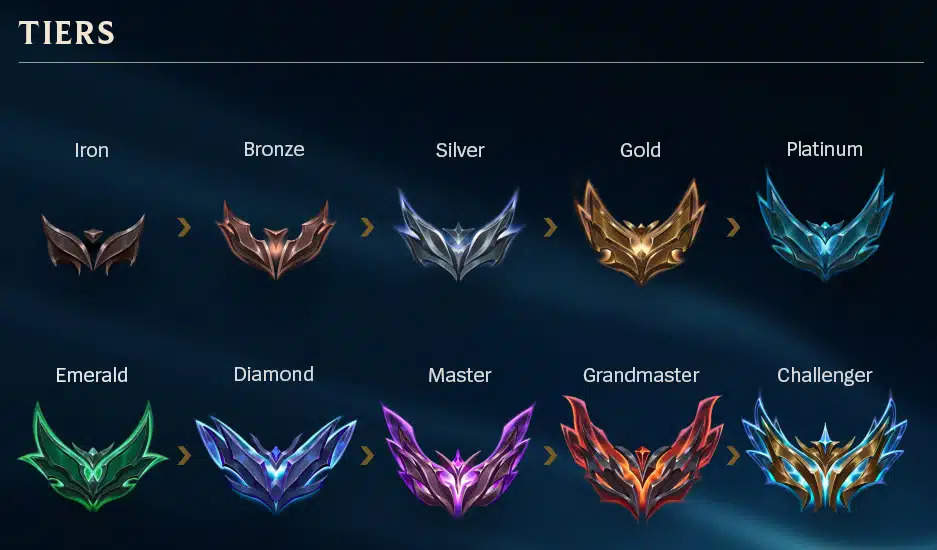
If you’re looking for League of Legends ranks in order, here’s the clean list from lowest to highest. This is also the easiest way to understand ranks in League of Legends without getting lost in jargon.
There are ten tiers in modern League of Legends:
- Iron
- Bronze
- Silver
- Gold
- Platinum
- Emerald
- Diamond
- Master
- Grandmaster
- Challenger
Iron through Diamond uses the four divisions system (IV, III, II, I). The apex tiers do not use divisions. Instead, they’re more like an LP-based leaderboard.
In Iron and Bronze, it all comes down to the fundamentals – last-hitting, avoiding ganks, and arriving at objectives in time. When looking at the upper echelon, Master and above is where you’re no longer climbing through divisions. You’re competing on an LP ladder, and your spot is about staying active and staying sharp.
Grandmaster and Challenger tiers are even more extreme because they’re limited and competitive by design. Challenger rank is the highest rank most players think of when they imagine “peak solo queue,” and it’s where you’ll find a lot of pros and semi-pros.
How Rank Decay Works
Rank decay only affects the top of the ranked ladders and exists to keep that tier active. It prevents someone from hitting a high tier, disappearing for weeks, and still occupying a valuable spot. In modern League of Legends, decay matters once you reach higher tiers, starting at Diamond and continuing through the apex ranks.
Here’s the practical version:
- You get a buffer of banked days.
- Playing ranked play adds banked days.
- If you stop playing and your bank runs out, you start losing LP every day.
Typical decay values you’ll hear referenced:
- Diamond: bank up to 28 days and then lose 50 LP per day once decay begins.
- Master, Grandmaster, Challenger: bank up to 14 days and then lose 75 LP per day once decay begins.
If you hit 0 LP due to decay, you can drop into the previous divisions or even the previous tier, depending on where you are. If you’re already at the lowest division of your tier, you can fall into the highest division of the previous tier. That’s why people talk about lol rank decay like it’s brutal, because it is if you ignore it.
There’s no reason to spam ranked matches on a daily basis. It’s best to plan out a few ranked matches per week so that your day balance remains positive, particularly when you’re in the middle of a ranked split, where you have something at stake.
Understanding MMR And Matchmaking In League Of Legends
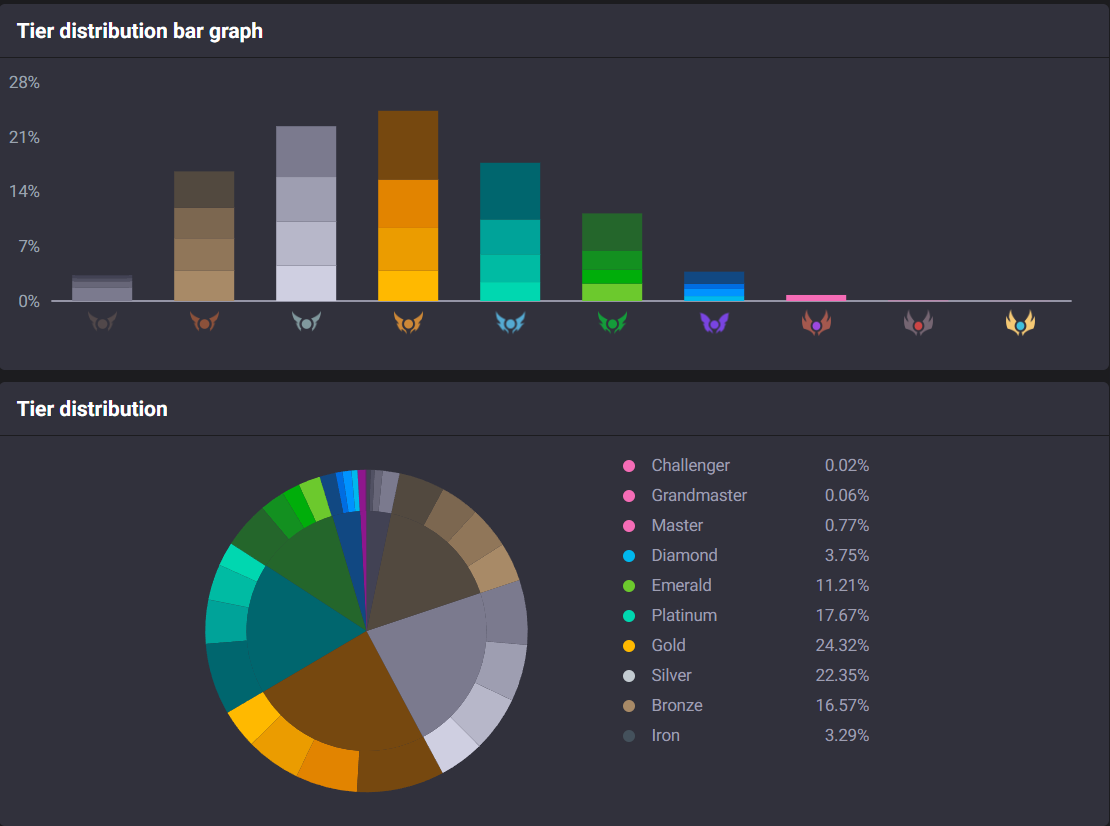
But there’s more to your rank than meets the eye. You also have a matchmaking rating, abbreviated as MMR.
Let me explain how it works:
- Rank: Your insignia.
- MMR: what the game uses for lobbies.
Your skill level in matchmaking is based on your player’s skill level over time, not just your last three games. Riot Games doesn’t show the number directly, but you can feel it through LP patterns and opponent strength.
MMR is influenced mainly by results over many games. Past performance matters in the sense that the system is always updating from your history, but the biggest lever is simply whether you keep winning against similar opponents.
Common patterns players notice:
- Win consistently and your MMR rises, which leads to more LP and easier jumps to the next tier.
- Lose consistently and your MMR drops, which can make you feel “stuck” because wins don’t pay out as much.
This is precisely the reason why talks about “loser’s queue” never really die out. As soon as you find yourself wondering if there’s anything wrong with the way your MMR and rank seem to be correlated, there’s definitely something going on. And it’s always the same old story—balance yourself out and start winning.
Placement Matches In League Of Legends Explained

Placement matches are the first set of ranked games played at the beginning of each season or split. Players will now get five placement matches, and their outcome plays a very important part in determining their starting ranks in League of Legends.
Some pieces of advice that really work during placement matches include:
- Playing the role that suits you, not one that you’re trying out;
- Limiting your pool of champions to avoid losses from indecision;
- Not going into a tilt when you’ve already lost two games, and getting yourself another game without winning a single game.
Your starting rank does not define your skills or potential. It is simply the starting point for the rank system to begin evaluating you.
Conclusion
It’s important to keep in mind that ranked play is a marathon, not a sprint. Approach each new split like its own season, setting realistic goals for yourself and tracking your progress once per week. You’ll find success in ranked when you maintain consistency rather than go on a bender.
Whenever you get to that point where you feel lost about what to do next, here’s the best advice I can give: Do the basics.
Thanks! Do share your feedback with us. ⚡
How can we make this post better? Your help would be appreciated. ✍







 Join Our Community